
Table of Contents
Dismantling Black Manhood
Chapter 3: The Impact of the Long March and the Middle Passage on the West African Concept of Manhood
Assaults on Manhood
The path to losing one's sense of manhood which was based in being able to defend oneself and protect one's family began as they were stripped of their ability to do so when being chained up and abused throughout their walk from the interior to the west coast. They further lost the ability to prove and demonstrate their manhood due to being chained together tightly against others under the deck of the slave ship. Furthermore, their ability to end their own lives to escape this suffering was stifled by that tight bondage which further added to their sense of helplessness making them further lose any semblance of African manhood. (Henry Prior)
Black argues that these assaults on West African Manhood served to “displace the West African male perception of himself.”1) The context of slavery stripped African men of the relationships and experiences that they used to define manhood itself. It was not simply a destruction of African manhood, then theoretically replaced by colonial or white manhood, but a destruction of manhood itself for those who experienced it. Additionally, the trauma and both the mental and physical displacement of the Middle Passage caused African men to lose their ability to reference the past as a way to assert their manhood. Previous experiences of performing masculinity were disconnected from any present claims to manhood, leaving African men without the structures to assert their own capabilities and possibilities. (Cameron Spivy)
One of the ways the article discussed the assaults on their manhood was through the changing of names and how that served to remove yet another connection to West Africa.The descriptions of how much meaning there was to names and reflected those connections to manhood. Not only did changing someone's name reflect ownership, it also reflected erasure. (Hannah Covin)
This section powerfully reframes the Long March and Middle Passage not just as physical displacement, but as a systematic gendered assault on West African manhood. The text shows that enslavement targeted core masculine values, especially virility, autonomy, and the ability to protect one’s family, through chains, public humiliation, sexual terror, and ritualised violence, transforming “warriors” into what Black calls “muted warrior.” What stands out is how domination was not only enforced through force, but through symbolic practices like shackling, branding, and witnessing the abuse of women and kin, which redefined African men’s social position from protectors to powerless observers. This makes clear that the destruction of manhood was not accidental collateral damage of slavery, but a deliberate strategy of control that reshaped identity before Africans ever reached the Americas. —(Caitlyn Edwards.)
The section touched and focused on how the European men were breaking and destroying the perceived manhood of West Africans, who were forced in to the Long March and the Middle Passage. The assaults against this manhood which the Europeans were trying to destroy was in order to instill their “dominance” over the West Africans. The assaults were both physical and mental, with the main focus of the physical harm towards breaking the manhood, the mental harm was connected through the removal of names, ability to help and/or protect their families, and seeing how their fathers and older men were beat into submission or killed. This assault was able to break the spirit of these West African men by removing the ability to follow in the footsteps of their ancestors, fathers, and other men in their families; it was able to destroy and reform the manhood of West Africans to better suit the needs of the Europeans who were enslaving these men. -(Sage Milton)
Resistance as Affirmation of Manhood
Although I have previously learned about the Middle Passage, I was unaware of the extent of the psychological and physiological horrors that occurred. The parallels between the general institution of slavery and the physical journal exemplify how Black manhood and masculinity have been impacted by systematic racism. In particular, I was intrigued to learn about the acts of resistance enslaved people took during this time. The author discussed how acts of resistance, such as starvation, were so widespread that extreme measures were taken to reduce the likelihood of men revolting. This week's text sheds light on how disenfranchising large groups of men may implicate women and girls. For instance, during the Middle Passage, West African women and girls were victimized by white captors. Overall, the text showed how the process of enslavement devastated communities with the onset of removing fathers, brothers, cousins, and grandfathers from their homes. (Allisya Smith)
Chapter 4: Plantation Existence and the West African Concept of Manhood
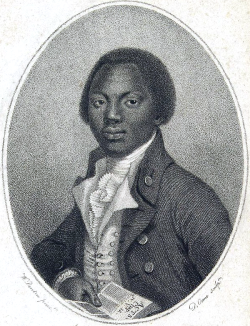 This chapter explores the experiences of Venture Smith (originally Broteer Furro) and Olaudah Equiano/Gustavas Vassa, who were both born in Africa and were enslaved as children. Black uses their written narratives of their lives to examine how ideas of manhood interacted with the lived experience of slavery. Both Venture and Equiano were originally raised with ideas and concepts of West African Manhood, that, after being enslaved and displaced, they felt they could no longer achieve. (Cameron Spivy)
(Right) Olaudah Equiano as portrayed in his autobiography. There are no contemporary portraits of Venture. (Cameron Spivy)
Physical Abuse and Manhood
D. Black describes in detail the examples of physical and mental cruelty that were meant to either subjugate the enslaved people or simply humiliate them. Among them was a horrifying mechanism called the Speculum Oris, which was supposed to keep the mouth open for compulsory feeding. This practice, in combination with jettisoning, rape, beatings, starvation, and neglect, constituted an immense physical and psychological pressure for the enslaved. D. Black argues that these conditions led to the creation of “Fixed Melancholy” - a particular mental phenomenon, which attempted to explain frequent deaths among enslaved people. At the same time, this form of abuse contributed to further process of “dismantling” of West African masculinity as a result of constant exposure to violence and a lack of options for the substantial response to reaffirm masculinity. - Nikolai Kotkov
On the plantation, as well as in West Africa, physical strength was a visible symbol of masculinity. However, what had been in West Africa a symbol of martial prowess and pride on the plantation was a result of forced, physical labor and was feared - not respected - by those in power. The physical strength of an enslaved African man, while useful to the profit margins of his enslaver, challenged the authority of that enslaver, who relied on physical force to maintain his position. As a result, African men who had the strength to resist were often physically abused to ensure subservience. Thus, physical strength, which would have given honor to a man in West Africa, could worsen one's treatment in the paranoia of the plantation system. (Nick Thodal)
This section shows how plantation violence functioned as a daily mechanism for redefining Black manhood by making physical strength and resistance liabilities rather than sources of dignity. Through figures like Venture Smith and Equiano, physical punishment became a tool not just for discipline but for psychological restructuring, teaching African men’s social position that survival required submission rather than defence. Plantation abuse thus completes the transformation begun in the Middle Passage, replacing warriors masculinity with enforced vulnerability and controlled obedience. —(Caitlyn Edwards)
Displacement from Familial and Social Roles of Manhood
Husband
On top of the extreme physical abuse that African captives aboard slave ships were forced to endure, countless women were also sexually abused by their white European captors. In West Africa, being able to protect one's family and community was a highly valued trait and was the mark of a great man, but aboard slave ships, husbands were completely physically unable to protect their wives from such sexual abuse. This inability to protect and avenge the suffering of their wives caused many West African men to view themselves as dysfunctional as husbands and as men, since, not only were they unable to prove their virility by defending themselves, but they were further unable to defend their wives. (Noah Rutkowski)
With the removal of traditional West African manhood, the typical husband that cares for, provides, and protects their wives is no longer allowed in the Plantation society that the West Africans have been brought to. This is also seen with the Long March and Middle Passage, through the bondage of the men and not allowing them to protect or comfort their wives who are being sexually assaulted. However, on the Plantations the further removal of allowing men to be husbands was also through the sale of the enslaved men, taking them from their wives and placing them on separate plantations across the state or in a different state. -(Sage Milton)
Father
Plantation life severely limited African men's abilities to father their children, specifically in ways that affirmed their own ideas of manhood. Specifically, in the case of sons, enslaved fathers were unable to impart cultural knowledge and ritually guide their sons on their journey to manhood. They were barred by the limited time they could spend with their family, through both overwork and separation, as well as the explicit prohibition of these practices. Additionally, in the context of their enslavement, fathers had to spend their precious time teaching their children how to survive in a world where white men held all the power rather than teaching their children about what adulthood and specifically manhood meant to them as Africans. (Cameron Spivy)
The notion of fatherhood that West African men had was impossible to maintain in plantation life, specifically for the first generation of enslaved men, whether they came over as adults or children. Fathers had very little time to care or teach their sons their culture or language. Within slavery and the new connection of manhood/ masculinity to race, the fathers were not seen or treated as men, and to some degree these enslaved men were sold to use as a way to create more workers for these plantation owners, not allowing them to be fathers to the children that they were forced to create. Fully removing the cultural aspects of fatherhood from these men. -(Sage Milton)
Black Manhood in the Media
Despite the black masculinity model encouraged discipline, respect, and moral constraint African American men still faced stereotypes (highlighted in the media) proving structural marginalization. Media represented black men as over masculine, sexual, and criminal beings which created consequences for both black men and women in society. The deconstruction of black manhood caused a reshaping of black womanhood and affects the gender hierarchy between black men and women, where both are faced with internal and external forms of domination. To redefine themselves, black men lean on community and cultural expression to push for change and recognition. They do this not as an attempt to mimic the white version of masculinity, but to challenge the validity of patriarchal masculinity. (Reiley Gibson)